 News
News
 Prediction
 Fixtures

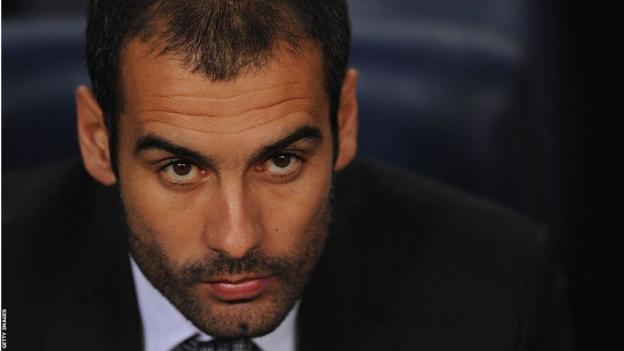
Jose Mourinho, Pep Guardiola, and the game that altered everything
A crucial decision at a certain point can lead to two divergent paths in history.
In 1998, a movie featuring Gwyneth Paltrow popularized the term ‘Sliding Doors’ and ten years later, football experienced its own Sliding Doors moment.
In the summer of 2008, Barcelona, under the management of Frank Rijkaard, faced a stagnation that seemed destined for a decline. After two consecutive trophyless seasons, Barcelona finished third in La Liga and suffered humiliation at the Bernabeu.
Get real-time football scores here!
Confirming Real Madrid as champions just days before, Barcelona had to honor their arch-rivals with a guard of honor onto the pitch before their league encounter.
The humiliation didn’t end there. A 4-1 defeat ensued, accompanied by Madrid fans chanting “Laporta please stay!” directed at Barca’s pressured president Joan Laporta.
Away from the football field, the influential figure in the dressing room, Ronaldinho, was dedicating more time to the city’s nightclubs than to scoring goals. Team discipline appeared to have dissipated, with reports of the Brazilian being allowed to rest and recover from the night’s indulgences instead of focusing on training.
Concerns about Ronaldinho’s weight gain and his inclination for a nightlife filled the front and back pages of Barcelona’s newspapers. During press conferences, every question directed at Rijkaard included the term “resign.”
With the echoes of Madrid fans’ disapproval still fresh, Laporta provided his response. Less than 24 hours after the humbling experience in Madrid, Rijkaard was dismissed.
The question of his successor arose. At the top of the list, and the preference for any practical football enthusiast, was Jose Mourinho. Mourinho had a positive history with the club, having served as an assistant to previous managers Bobby Robson and Louis van Gaal. His impressive CV included Uefa Cup and Champions League victories with Porto, as well as back-to-back Premier League titles with Chelsea.
However, instead of choosing the high-profile football celebrity, Barcelona opted for someone from the B-list, quite literally. They selected their own B team manager, someone untested at the top level, who had spent the previous season, his first as a manager, in Spain’s fourth tier and a Catalan regional division.
The choice?
Guardiola over Mourinho.
To comprehend this decision that reshaped football, one must delve into the essence of Barcelona’s DNA, where poetry, not pragmatism, serves as the primary motivator. Here, one man’s methods, opinions, and intuition take precedence over everything else.
The BBC Sport documentary “Pep Guardiola: Chasing Perfection” delves into why Pep’s understanding is rooted in Johan Cruyff. Cruyff is synonymous with Barcelona, achieving success both as a player and manager. He won La Liga in 1974 and the Copa del Rey in 1978 as a player. Later, he secured four consecutive Spanish top-flight titles and the European Cup as the club’s manager from 1988 to 1996. Cruyff held a profound influence on Guardiola’s career.
Cruyff recognized Guardiola’s potential, plucking him from the Barcelona reserves in 1990 and placing him into a star-studded first team alongside global talents like Michael Laudrup and Ronald Koeman. In the eyes of Cruyff, Guardiola possessed enduring qualities.
Spanish journalist Lu Martin, who ghost-wrote Guardiola’s little-known 2001 book “La Meva Gent, El Meu Futbol” (My People, My Football in Catalan), sheds light on Guardiola’s significance. “In Catalonia, we say ‘seny’ and ‘rauxa.’ [Barcelona captain Carles] Puyol has ‘rauxa’ – impulse, drive,” Martin explains. “The ‘seny’ – the brains – at FC Barcelona was Pep. Pep brought sense to the team because he could understand everything Johan wanted from him. Johan had two sons: Jordi, his son by blood, and his sports son…Pep.”
Jordi Cruyff supports Martin’s evaluation of the close relationship between his father and Guardiola.
Jordi recalls his father expressing immense confidence in Guardiola’s potential as a manager, especially after Guardiola concluded his playing career with less successful stints at Brescia, Roma, Al-Ahli, and the Mexican club Dorados.
“After Pep’s retirement in 2006, I know there was a lot of communication between him and my father,” Jordi Cruyff reveals.
“I believe my father had a kind of intuition that allowed him to sense when someone has the potential to be a great coach.”
A common critique of Guardiola is that all three of his high-profile managerial positions – Barcelona, Bayern Munich, and Manchester City – have been at clubs with renowned players and substantial financial resources. The implication is that Guardiola might struggle to showcase his managerial prowess in a smaller, more modest setting.
The challenge couldn’t have been more modest than at Barcelona B.
“Yes, I may have been a player, but as a coach, I will start from scratch,” asserted Guardiola, then 37, during his inaugural press conference as the head of Barcelona B.
The decision to take on the coaching role was surprising, considering that he had the option of a more prestigious position as the head of the academy.
Both Guardiola and Barcelona B were embarking on a new beginning. In the preceding season, the team had suffered relegation after failing to secure victory in their last 10 matches.
Guardiola’s managerial journey kicked off with a pre-season friendly against Banyoles, played on a compact, artificial pitch. The challenges of managing on smaller pitches and, when games were played on grass, dealing with uneven surfaces became evident in the initial stages.
Barcelona B managed to win just one of their first three matches. Following a 2-0 defeat by the struggling Manresa, who were eventually relegated, Guardiola faced his first test of conviction. The question was whether his playing style, emphasizing possession over positional play on the field, could thrive in the challenging conditions of the fourth tier.
After contemplating for two days, Guardiola arrived at training on the Wednesday following the defeat, having made up his mind. He decided, “I had thought we have to change because the pitches are so small.”
“I doubted for two days. But, in that moment, I decided – if we could win and play quite good football on a small pitch, I could do it at a higher level with better players and better pitches.”
“I arrived at training and said: ‘This is what I believe.’ The alternatives, the ways we looked at changing, they did not convince me. That is why I could not change.”
“It was a crucial moment because I was new, lacking experience at 37, and had never trained prominent players. I had to establish myself.”
One individual who didn’t require proof was Domenec Torrent. Torrent had been managing another fourth-tier team, Girona. When Guardiola, a figure he had admired as a player, approached him, Torrent eagerly accepted the opportunity to join forces.
Torrent spent 11 years as Guardiola’s assistant before departing Manchester City for a head coach position with New York City FC in 2018.
“I always say Pep has incredible powers of persuasion,” he remarks.
“He’s someone who can convince players through his everyday work with them. He’s a sponge.
“He quickly learns about everything and everyone.
“He transformed Barcelona B into a well-organized team that played exceptional football. He effectively conveyed his ideas to the players, which were entirely different from anything they had encountered before.
“It’s true that we built a very strong squad.”
Sergio Busquets, Pedro, and Thiago Alcantara were newcomers in that squad, and Guardiola stood as the unwavering, relentless, and ruthless driving force at its core.
Professionalism took precedence. Opposing teams were meticulously scouted and subjected to video analysis, a level of detail uncommon in that division at the time.
Guardiola implemented an 11 pm curfew and introduced fines.
“Pep had very clear boundaries; he did not allow anything he deemed out of place,” recalls Pep’s then-captain Marc Valiente. “He had a very clear code. You had to adhere to that in terms of rules and fines, and I think that was fair.”
Barcelona’s then-sporting director Txiki Begiristain, now in the same role at Manchester City, also recalls Guardiola’s pursuit of perfection.
“It was unbelievable,” says Begiristain. “In England, the level would be like League Two. Pep was working in League Two as if he were in charge of the [Barcelona] first team: looking after the players, food, chefs, traveling, recording the games. He was really amazing. He was thinking, ‘One day I’m gonna be a first-team coach, I wanna work like this.’ And so, he was already doing it in the fourth tier. It was crazy.”
Despite a challenging start, Guardiola’s Barcelona B saw a dramatic improvement in form, eventually securing promotion.
Guardiola’s work ethic gained recognition in the boardroom, particularly from the most influential face of Barcelona.
“I remember that Johan Cruyff visited a lot with his wife to see the Barca B games,” recalls Torrent. “Strangely, I saw that instead of watching the game, he was watching Pep—how he managed, how he behaved, how he moved: his body language. I remember mentioning to Pep: ‘That’s the second time Johan’s been to see you, and he was just watching you.’ All that made sense when Pep took over the first team. I remembered those afternoons when Johan came to see him, not the football.”
The promotion came at a significant cost for Guardiola.
At the start of the season, Guardiola had promised to treat the team to lunch if they managed to win three consecutive games. This feat occurred on five occasions.
The team’s most crucial performance, however, took place in a friendly against Rijkaard’s increasingly disorganized and disinterested first team, witnessed by only a few spectators.
Former Barcelona forward Eidur Gudjohnsen recalls, “I don’t think I ran and chased the ball as much ever.”
The friendly, coupled with Cruyff’s weekly scouting reports, played a pivotal role in convincing the Barcelona board that Pep was the right choice for the top job.
“They had a certain way of playing,” says Gudjohnsen. “It was almost as if we couldn’t get near them. I’m pretty sure some of the first-team players didn’t take it as seriously as we should have. But I still remember that I thought: ‘Wow, how are they playing? Why is there always a spare man?’ It was very difficult to pressure them.”
For the first team, the match turned into an embarrassment. Ronaldinho was substituted after just 10 minutes, and Deco reportedly struggled against the relentless reserves.
Guardiola’s pressure also proved too much for the Barcelona board. The combination of the B team’s promotion, the farcical friendly, and Rijkaard’s reluctance to discipline his unruly squad prompted a change at the helm.
The decision came down to two options: Europe’s top dog, the all-conquering disciplinarian Jose Mourinho? Or the poetic choice, the possession-obsessed Pep Guardiola?
Xavier Sala-i-Martin played a central role in those discussions as Barcelona treasurer and a board member from 2004 to 2010.
He recounts in “Pep Guardiola: Chasing Perfection,” saying, “Everybody knows we have this problem. Ronaldinho plays bongos until two in the morning every night. How do you stop it? We need a sergeant, a general. Who is the greatest general in the world? Jose Mourinho, right? Given the problems we had, the solution seems obvious. Unfortunately, Mourinho doesn’t fit with Barcelona’s DNA. Barcelona DNA has many aspects. One of them is the way we play. We inherited these from Johan Cruyff. We win when we play Dutch-style football. The best student of Cruyff is Pep. But Mourinho has won the Champions League. So there was a big debate. But Joan Laporta said: ‘We cannot go Mourinho’s direction… he doesn’t play our style. He’s a defensive manager with counter-attacks. That’s not the way we play.’ And also, he’s not a real gentleman. The way he tries to manipulate, he doesn’t act the Barcelona way on the field.”
It remained a decisive moment, as Sala-i-Martin recalls, with the outcome still hanging in the balance until one man stepped in.
“A lot of board members leaned towards Mourinho,” he said.
“Laporta sought advice from Johan [Cruyff] and asked, ‘Do you think Pep’s ready?’
“And Johan affirmed yes. When Johan says yes, it’s yes.”
In the end, the influential figure of Johan Cruyff, a key member of Barcelona’s A-list, advocated for an untested manager from the B team.
Since then, football has undergone a significant transformation.