 News
News
 Prediction
 Fixtures

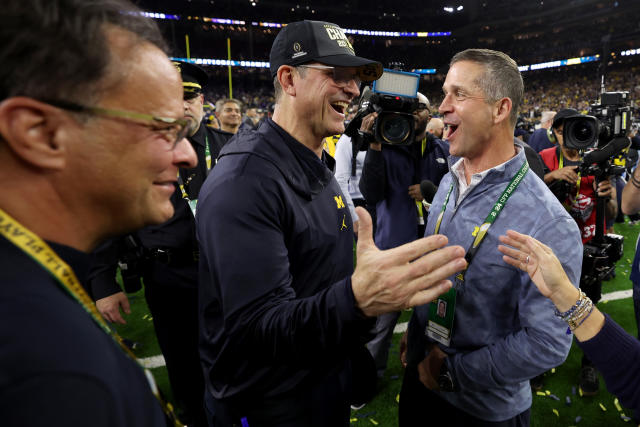
Jim Harbaugh could stay at Michigan, but the opportunity for a Super Bowl with the Chargers was too tempting to decline
Almost 11 years ago, Jim Harbaugh was in a pivotal Super Bowl moment with his San Francisco 49ers. Trailing the Baltimore Ravens by five points with 2:39 left on the clock and a first-and-goal from the 7, Harbaugh had four opportunities to score a touchdown, potentially securing the championship and solidifying his coaching legacy. However, the vaunted Ravens defense thwarted all four attempts, denying Harbaugh the Super Bowl victory. Instead, his brother John and the Ravens celebrated with the Lombardi Trophy.
Even though John praised Jim as the “no greater coach in the NFL,” expressing genuine admiration, it was not specifically directed at his younger brother. This near miss haunted Jim Harbaugh, and the aspiration to claim a Super Bowl victory eventually remained with him. This desire persisted even after Harbaugh spent nine years in the college coaching ranks, leading his alma mater, Michigan, to a national championship.
Latest American Football League Scores & Updates
Jim Harbaugh has returned to the Los Angeles Chargers, becoming the head coach of the franchise where he concluded his 14-season quarterbacking career, formerly based in San Diego. In the meantime, insider sources indicate that Sherrone Moore, Michigan’s offensive coordinator, is the frontrunner to assume the Wolverines’ head coaching role. Moore, aged 37, who also oversaw the team’s highly regarded offensive line, served as interim head coach during Harbaugh’s suspensions in 2023, securing four wins, including a notable victory over Ohio State, where his play-calling and game management were praised.
At the age of 60, Harbaugh inherits a promising Chargers roster featuring the exceptional young quarterback Justin Herbert. A high-caliber quarterback is often deemed essential for success in the NFL, and Harbaugh undoubtedly returned to achieve nothing less.
Despite leaving behind a Michigan program coming off a triumphant 15-0 national championship season, securing the third consecutive Big Ten title and a third consecutive victory over archrival Ohio State, Harbaugh’s decision to depart was unexpected. He enjoyed a comfortable position in Ann Arbor, considered a local hero with family members on his coaching staff and his parents residing in the house next to his. The Wolverines presented a lucrative six-year deal worth $11.5 million annually, excluding potential performance bonuses, initially aiming to make him the highest-paid college football coach. They made a last-minute effort to retain Harbaugh by further enhancing the offer.
In essence, Jim Harbaugh’s departure was not a necessity; rather, it stemmed from his desire. The primary motivation behind his move was the pursuit of winning a Super Bowl.
Two years ago, Harbaugh anticipated securing a job offer after a final interview with the Minnesota Vikings in Minneapolis. However, the offer did not materialize, leading to Harbaugh’s commitment to refrain from pursuing further NFL opportunities. Yet, a year later, he found himself fielding more NFL calls, and this time, it was Harbaugh choosing to step back from potential interest in Denver.
Part of the motivation was to coach a team with a talented returning roster capable of securing the school’s first outright title since the 1940s (the University of Michigan had won a share of the 1997 national championship).
After achieving the national title, there seemed to be little left for Harbaugh in Ann Arbor. He initially took the Michigan job after a disagreement in San Francisco left him unemployed despite an impressive record of 44-19-1, two NFC title game appearances, and a Super Bowl trip within four years.
Michigan, at the time of Harbaugh’s arrival, was a struggling program, posting a 24-36 record in Big Ten play over the previous eight seasons. It faced dominance not only from Ohio State but also from Michigan State and other opponents. This contrasted sharply with Harbaugh’s experiences playing under Bo Schembechler.
With all family matters addressed, few at Michigan anticipated Harbaugh staying if presented with a favorable opportunity. However, his departure leaves behind a complex legacy, marked by multiple ongoing NCAA infractions cases. One case involves allegations of Harbaugh misleading NCAA investigators regarding Level II violations within the program, while another revolves around the Connor Stalions advanced scouting operation, which is accused of aiding in the theft of opponents’ signs.
Michigan took preemptive action by imposing a three-game suspension on Harbaugh at the beginning of the season for alleged NCAA infractions, while the Big Ten administered an additional three-game suspension towards the end of the season. Despite these measures, the NCAA may still impose further sanctions. However, these concerns are now secondary for Harbaugh. Winning the national title, particularly defeating five ranked opponents after the sign-stealing scandal, has seemingly vindicated his success in the eyes of the NFL and even received acknowledgment from NCAA president Charlie Baker, who stated that the Wolverines won “fair and square.”
Sherrone Moore, if appointed as head coach, would inherit the responsibility of navigating potential NCAA sanctions. His initial challenge would involve ensuring the team remains intact in Ann Arbor and prevents players from entering the transfer portal within the 30-day window following a head-coaching change.
Michigan boasts a roster with ample talent, although the departure of key players like quarterback J.J. McCarthy and running back Blake Corum to the NFL Draft may impact the team’s strength compared to the previous season.
For Harbaugh, the focus shifts back to football, free from the distractions of investigations, contracts, legal matters, recruiting, and the complexities of the NCAA rulebook. Renowned for building competitive cultures, Harbaugh’s expertise aligns with the Chargers’ goal of establishing a strong fan base and market share in their city through on-field success.
Harbaugh and Herbert face the task of rejuvenating the Chargers, a second-tier franchise, by winning games and capturing the city’s attention—an opportunity Harbaugh has eagerly awaited for a considerable period.